Free
Try the platform on full tests before you pay.
£0
No card, no account.
What you get
- 11 free tests
- No registration required
- Step-by-step solutions
- Detailed test reports
- Accessible on any device
Can we use analytics cookies? They show us how the website is used, so we can improve it. Read more in our privacy policy.
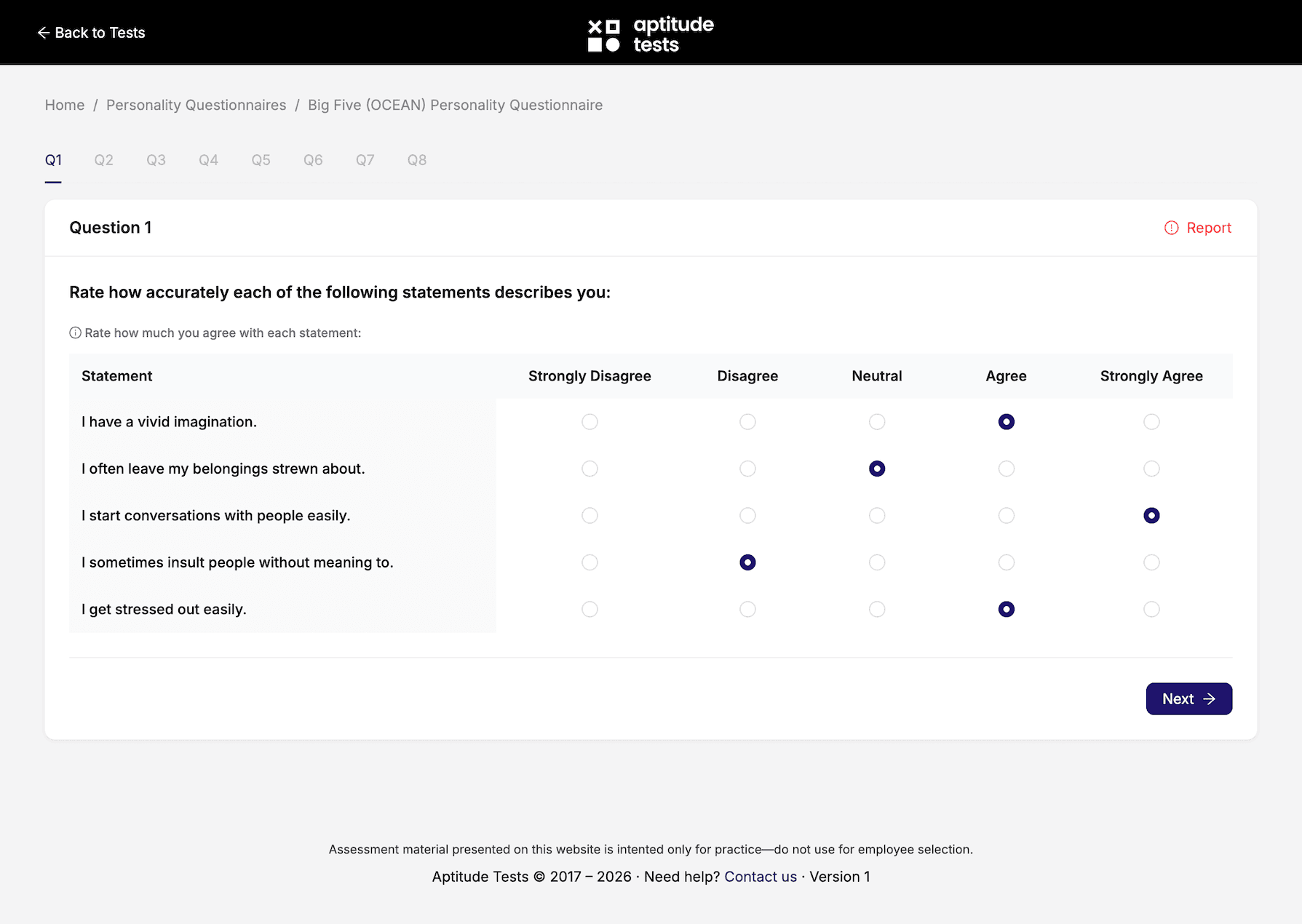
Employers use personality questionnaires to see how you are likely to deal with people, tasks and pressure at work. Practice on Big Five and workplace personality questionnaires, and get a trait report after each one.
4 questionnaires, trait reports, 3 months access. 14-day money-back guarantee.
How true of you is each statement?
I write a plan before I begin a task.
I start conversations with strangers.
I enjoy ideas that are new to me.
I worry about what could go wrong.
I assume that people mean well.
How true of you is each statement?
I tend to be quiet in a group.
I make time to help a colleague.
I leave tasks until the last minute.
I am curious about how things work.
I stay calm when things go wrong.
How true of you is each statement?
I prefer routines that I know well.
A setback stays on my mind for days.
I feel energised after a busy meeting.
I read my work twice before I send it.
I find it hard to forgive people.
Each trait is scored from 0 to 10.
Sample questions: rate a statement to try it. In the app the profile comes at the end, with your report.
327 practicing right now
1 more questionnaire in the package
No subscription and nothing renews. Buy the packages you need at £9.99 each, or get all six for £29.99. Every paid plan is covered by a 14-day money-back guarantee.
Try the platform on full tests before you pay.
What you get
Only the packages your employer uses.
Choose your packages
Inside Personality
All six packages, for £29.95 less than buying them one by one.
Everything included


14-day money-back guarantee on paid plans. Terms and conditions apply.
A short guide to the questionnaire: what it is, who uses it, the formats, what it measures, how it is scored and how to prepare.
A personality questionnaire asks how you usually think, feel and behave at work. You read short statements about yourself and rate each one, or choose the one most like you and the one least like you. No answer is right or wrong, and nothing has to be worked out.
Your answers add up to a profile: a score on each of a set of traits, such as how outgoing, organised or calm you are.
Employers set one for graduate, professional and management jobs. They want to know how you are likely to go about the work, which a reasoning test cannot tell them.
Some send the questionnaire in the same email as the reasoning tests. Others send it after shortlisting, and use your profile to plan the interview. Our company pages list the hiring stages at each employer.
There are two main formats. In the first you rate every statement on a scale from strongly disagree to strongly agree. In the second you are shown three or four statements at once and choose the one most like you and the one least like you.
Each publisher builds its own questionnaire from these, with its own length and its own names for the traits. Our practice questionnaires cover both formats.
Three statements a question: choose the most and the least true of you. Untimed.
Statements rated on a five-point scale. A reasoning section of 10 to 20 questions comes with it.
Four adjectives a question: choose the most and the least like you.
These are the publishers' own figures for their current questionnaires. Your invitation names the one you will take. SHL, Talogy and Thomas are trademarks of their owners, who are not connected with this site.
A personality questionnaire measures traits, and psychologists group most of them under five broad ones, known as the Big Five: openness, conscientiousness, extraversion, agreeableness and neuroticism.
Questionnaires written for work report narrower traits, sometimes thirty or more, with names like persuasive, detail-conscious or resilient. No trait is good or bad by itself. A score that suits a sales job may not suit an audit job.
Each answer adds points to the trait its statement belongs to. With most publishers your total for a trait is then compared with a large group of other people and placed on a scale, often from 1 to 10.
The result is a profile, with a short description of what each score means, and that is what the employer reads. Our report compares you with no one: it places each trait on a scale from 0 to 10 from your own answers, and describes the lower and the higher end of it.
You cannot revise for it, but you can get used to it. Try each format once before the real one: choosing between four statements that all describe you is uncomfortable the first time.
Answer as you are at work, not as you would like to be, and do not dwell on a statement. A questionnaire comes back to each trait several times in different words, and many reports show how consistent your answers were. Then read your own report before the interview, so you know what it says about you.
The most recent are shown first.
4.5 out of 5
383 ratings
Elena V.
Aon tests
AON assessment
Although I didn't pass a final round of the Aon interview, this platform helped me boost my psychometric skills. Don't expect to pass any assessment after practicing here for an hour or so. You need at least 5-6 days to learn the logic and brush the timing skill as well. Overall, I would recommend this website.
Alexey R.
Robert Bosch GmbH tests
Recommend
High-quality questions and explanations.
Aisha N.
TotalEnergies tests
Good resources
Gayatri A.
ArcelorMittal tests
All good!
Monika A.
Robert Bosch GmbH tests
Good
Impressive variety of tests available
Abdul V.
Good to try
A questionnaire often comes with a reasoning test or two. Pick a package to see what it covers and who it is for.
Numerical Tests
14 testsDetailed solutionsSHL, Kenexa style
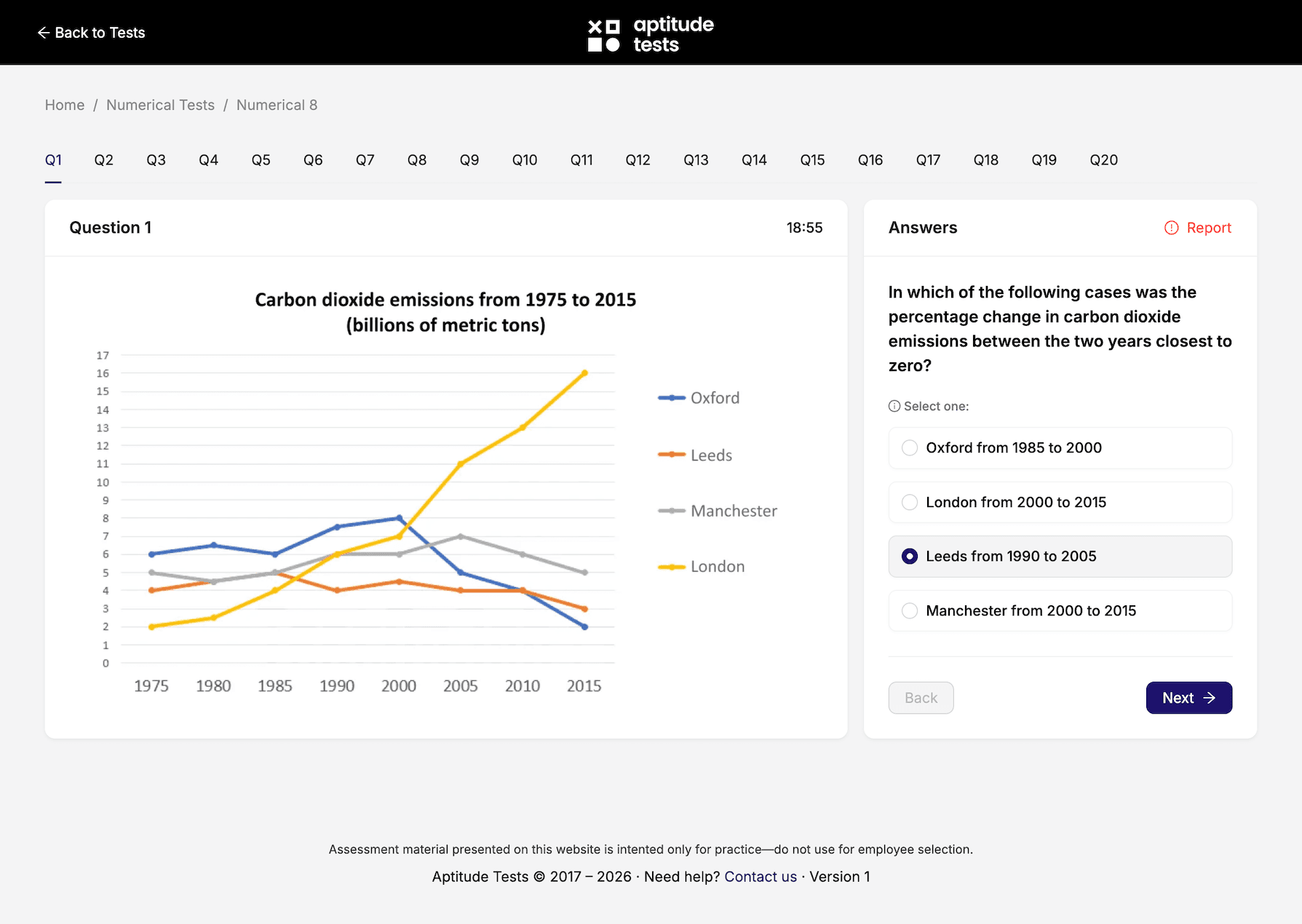
Numerical reasoning tests assess how quickly and accurately you interpret data. Practice SHL and Kenexa style questions with a written step-by-step solution for every answer.
Short answers to what candidates ask most.
The full FAQ covers payments and your account. For anything else, write to support@aptitude-tests.co.uk.
Not in the way you fail a test: no answer is marked wrong, and the questionnaire has no pass mark of its own. But the employer matches your profile to what the job needs, so a profile far from it can count against you. The CIPD, the professional body for HR in the UK, tells employers that test results should never be the sole basis for a selection decision.
No. A row of neutral answers puts every trait in the middle and tells the employer nothing about you. Use the middle when a statement really is neither like you nor unlike you, and commit to a side the rest of the time.
Often not. SHL's has no time limit, and other publishers give only the time theirs usually takes, from under 8 minutes for a short one to 40 for a long one. Your invitation says if yours has a limit. Ours show a suggested time, and you choose whether the timer runs.
No, and its own publisher says so. The Myers-Briggs Company calls using it in recruitment or selection unethical, and says that a personality type does not show skills or job performance. The questionnaires employers buy for hiring measure traits on a scale, as the ones on this page do.
No. Each publisher writes its own statements. Ours use the same two ways of answering, so on the day the way of answering is familiar.
Yes, there are two. The first, Big Five (OCEAN) Personality Questionnaire (Sample), has 3 questions and takes about 5 minutes. Each one ends with a trait report, and you do not need an account or a card.
4 questionnaires with 125 questions between them, in both formats, and each one ends with its trait report. It costs £9.99 for 3 months unlimited access, no auto-renew.
Yes. Every paid plan has a 14-day money-back guarantee. If something is wrong with the platform or the tests, email us within 14 days of buying. If you have started no more than three tests in a package, or four on the All-in-One, we refund what you paid. Other conditions apply.